Paper, Pencil and Dice. Why Have Roll-and-Write Games Hooked Me?
Paper Dungeons introduced me to the joy of marking up game sheets. Here is why roll-and-write games appeal to my love of legacy games, solo play and offline board gaming.
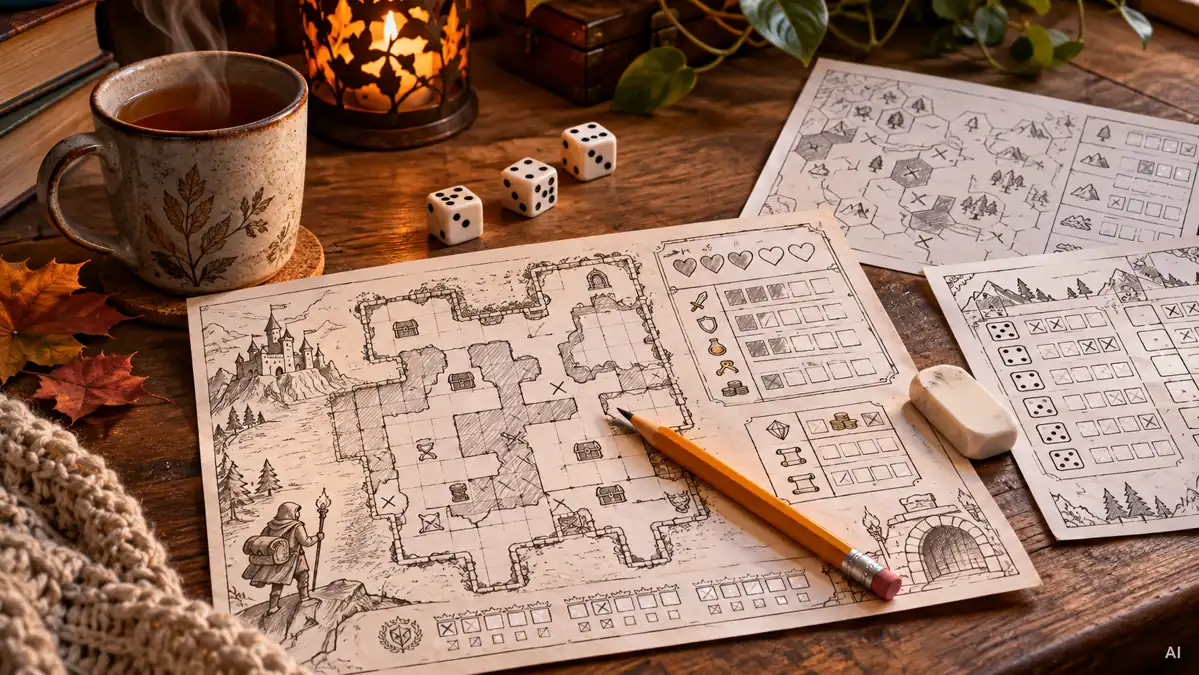
It started with Paper Dungeons. Not with the discovery that dice exist, or some grand revolution in board gaming. I simply found myself doing something I unexpectedly enjoyed: writing and marking things directly on a game sheet. The paper was no longer just a place to record a score. It became a record of what I had done.
That was what got me interested in roll-and-write games and other paper-and-pencil games. Not because I suddenly stopped liking traditional board games. I had found something I have always enjoyed: being able to physically change what my own game looks like.
Paper Dungeons. Where it started.
In Paper Dungeons, I guide a party through a dungeon, make decisions and mark their consequences on my sheet. There are dice, monsters and characters to develop. Yet the thing that stayed with me wasn’t a particular score or one brilliant move. It was the simple pleasure of writing on the sheet as part of the game, rather than as a bit of bookkeeping on the side.
What appeals to me most is that the next play can turn out completely differently. The rules stay the same, but the circumstances and choices change, and so does the sheet. It doesn’t feel like I’m merely repeating a sequence of moves I’ve already learned.
That doesn’t mean I’m declaring Paper Dungeons the best roll-and-write game ever made. Nor am I going to pretend I’ve explored the whole genre. It’s simply the game that started my current enthusiasm.
I like games that leave a mark.
Board games have always involved physical actions. We move pieces, shuffle cards and arrange tokens. But I get a particular satisfaction from changing something myself: writing, circling, drawing or crossing something out.
I like that hands-on side of games. I’m not necessarily talking about complicated game mechanics. I mean the actual thing I do with my hands. When I look at a sheet filling up, I can see more than the current game state. I can see the consequences of my choices. Someone else playing the same game would probably end up with a different-looking sheet.
Perhaps that sounds trivial. It’s still just pencil and paper, after all. Yet that tiny detail is precisely what makes me want to explore more games built around recording decisions.
What do roll-and-write games have in common with legacy games?
I love legacy games, especially the part where you’re allowed to change something permanently: add a sticker, alter a component or even destroy something you won’t be able to restore later. I know that treating the contents of a board-game box that way isn’t for everyone. For me, it’s part of the attraction.
I like knowing that, after a series of decisions, my copy might look different from someone else’s. Not because either of us played better, but because we made different choices and the game retained their consequences.
Roll-and-write games aren’t the same as legacy games, and I don’t want to pretend they are. In a legacy game, changes often carry over to future sessions. In a roll-and-write game, they usually belong to one sheet and one play. But both give me something similar: a tangible record of my own decisions. I suspect that’s why this new interest feels so familiar.
A board game should be offline.
There is one other thing I’m fairly uncompromising about. I don’t like board games that require a phone or a computer to play. For me, a board game should be offline.
I already spend enough of my day looking at screens. When I sit down to play, I want to take a box off the shelf, lay out the components and get on with it. No app to install, no update to check, and no phone sitting next to the dice as yet another required component.
I’m not saying digital companions are inherently bad. Other people may genuinely enjoy them. They’re just not what I’m looking for. A pencil that never needs charging is rather convincing technology in that respect.
Playing solo isn’t a backup plan.
A large part of my board-game collection is built around games I can play on my own. I also have multiplayer titles, but solo play matters to me. If I feel like playing a game, I don’t want that to depend on whether someone else happens to be available.
Roll-and-write games and related dice-and-paper games fit that idea nicely. That doesn’t mean every one of them is automatically brilliant solo. You have to find that out at the table, not from the box. Still, being able to take out a sheet and play by myself is a real advantage.
After Paper Dungeons, titles including Paper App Dungeon (Kieszonkowe Podziemia), Trek 12 and CATAN Dice Game caught my attention, along with several others. One important caveat: I haven’t played those games yet. They’re waiting their turn. So I won’t rank them or pretend I know how they hold up after a dozen plays. For now, they’re games I’m looking forward to discovering.
Neither shelf space nor spare time is infinite.
There are two rather ordinary limits to all this enthusiasm. The first is shelf space. Another box isn’t going to fit just because I ask the shelf nicely. The second is time. It’s perfectly possible to want to play five games and still only have enough of an evening to read the rules for one.
I’ve written before about Poczta Planszówkowa and why I like the idea of trying games without having to buy every single one. Now I have several titles of my own that deserve more attention. The challenge is finding the time before another interesting box comes along.
I’m hoping the longer autumn evenings will help me catch up. Maybe I’ll finally work through some of that backlog. Or perhaps the most useful game in my collection would be one where I mark free hours on a calendar.
For now, I know this much: Paper Dungeons opened the door to roll-and-write games, and I’m keen to find out what’s on the other side. I don’t need an app or another player for that. A table, a sheet of paper, a pencil and a little time will do. Especially the time.

Komoot and Cycling Navigation: After One Route, I Have More Questions Than Praise.
Komoot was supposed to make my cycling trip easier. I found a route on my computer, saved it, added nearby geocaches and set off. After one ride, though, I have more questions about the navigation than reasons to praise it.
The Market Is Increasingly Deciding When We Buy a Computer.
I heard about Apple computer price increases just as I was seriously considering replacing my Mac mini. My first reaction was not anger but sadness: planning a sensible upgrade is becoming harder when the market keeps moving the goalposts.

1670 Season 3 and the Art of Laughing at Our Own Flaws.
I watched the third season of “1670” and enjoyed it more than the second. It has better pacing, more laughs and the kind of absurd humour that lets you relax without overthinking every scene.