HF650LLL: 650 Years of Lubatowa, 1,885 QSOs and a Reality Check.
I organised and operated HF650LLL to mark 650 years of Lubatowa. I made 1,885 QSOs, even though a busy schedule left room for just one portable outing.
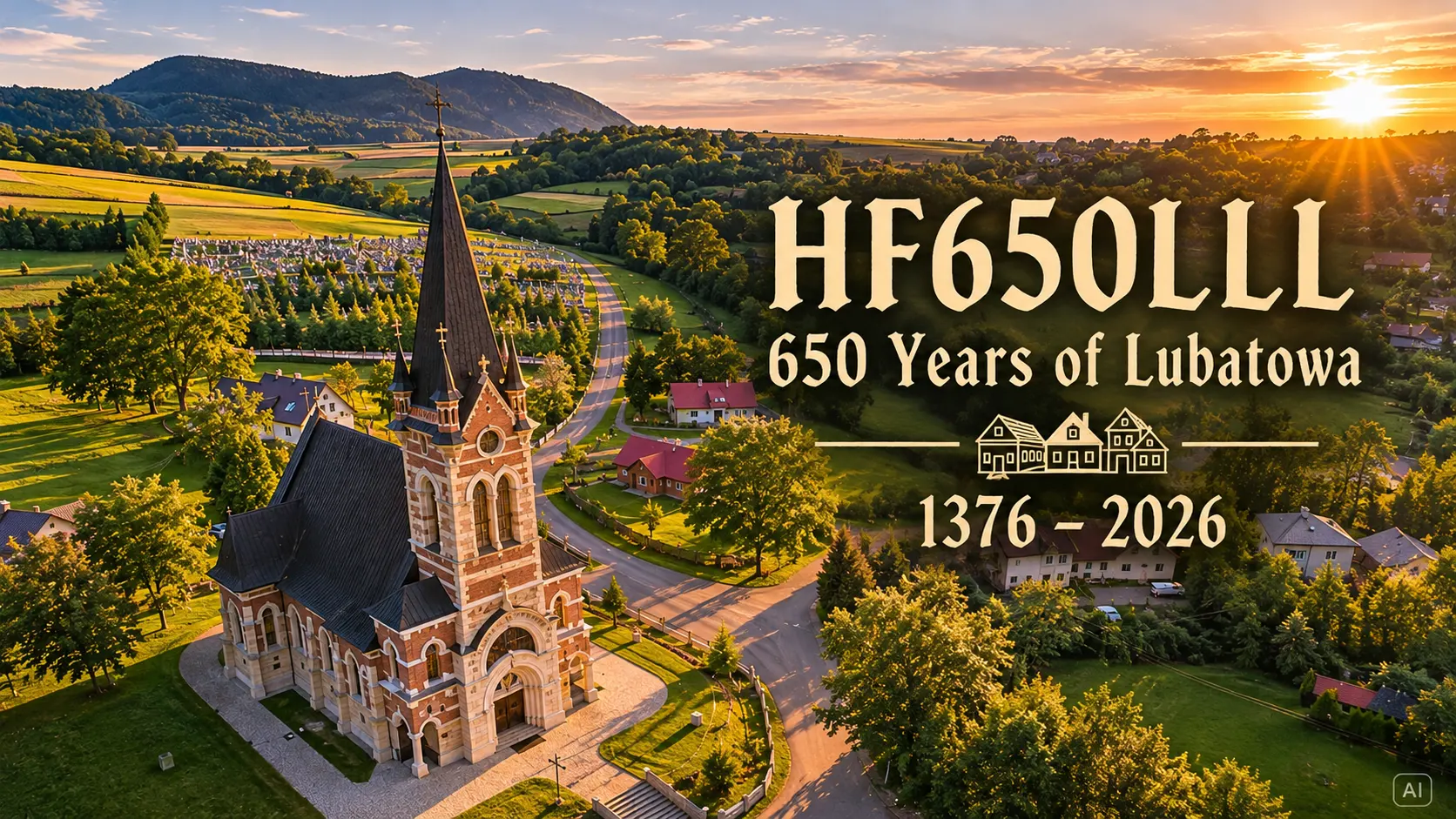
I finally found a little more time for radio and thought I could give HF650LLL some proper attention. Then I checked the dates and realised that the special-event callsign had already expired. That probably sums up the event I organised and ran on my own better than anything else. I had plenty of plans. Free time was in much shorter supply.
Why Lubatowa?
In 2026, Lubatowa marked 650 years since its foundation charter. I live here, so this was not just another anniversary on a calendar. Six hundred and fifty years seemed like a good enough reason to do something to mark the occasion. And because I am a radio amateur, an award event felt like the natural choice.
The historical reference point is a charter dated 15 March 1376, signed in Sanok by Władysław Opolczyk. It entrusted Stanisław Thoka with establishing a settlement between the Schowa and Lubachowa streams. The local Lubatowa historical association provides more background on that document and the village (in Polish).
That is how HF650LLL came about. I published the rules and awards on RadioDyplom.pl. The authorised event period ran from 21 June to 23 September 2026. I handled the organisation and the on-air operation myself; every contact logged under HF650LLL was mine.
An ambitious plan met a busy calendar.
At first, I wanted to operate portable much more often. The idea was to get out into the field with the radio regularly and give the anniversary a bit of an outdoor element too. In the end, I managed just one portable outing. I also only managed one occasion operating by voice.
It was not a lack of interest. I simply had a lot going on and very little free time. Around the same period I was also running HF10SQ8W, marking ten years of my amateur radio activity, and I helped create HF26WBC. Each project looks quite manageable on its own, right up until they all start competing for the same hours of the day.
The most telling moment came when I finally had a little more time for HF650LLL and realised the callsign period was already over. I could hardly have come up with a better illustration of how stretched my schedule had become. It was not the plan, and there is no point pretending otherwise.
1,885 QSOs and 58 DXCC entities.
Despite those limitations, I made 1,885 QSOs, of which 1,833 were valid and counted towards award points. The event attracted 1,488 participants representing 58 DXCC entities. I made my first contact on 23 June and my last on 20 August 2026, although the callsign was valid until 23 September.
Germany accounted for the largest number of participants (352), followed by Poland (133), the Netherlands (124), European Russia (124) and Italy (118). There were also stations from the United States, Japan, Brazil and Indonesia, among many others. I use the term DXCC entities deliberately: they are not the same thing as countries.
These numbers are not going to turn amateur radio upside down. But for an event I ran alone, with much less operating time than I had hoped for, I am happy with the result.
Digital modes dominated the contacts.
FT4 and FT8 accounted for nearly all my contacts. I made 1,005 QSOs on FT4 and another 841 on FT8. Together, that is 1,846 contacts – almost 98 percent of all QSOs. There were also 26 SSB contacts, 10 on FM and 3 on FT2.
I used 11 bands. The busiest was 20 metres with 879 QSOs, followed by 40 metres (205) and 15 metres (183). I also made 90 contacts via the QO-100 satellite on the 13 cm band.
I have never hidden the fact that I enjoy digital modes. I have written separately about why I like FT8, FT4 and RTTY. With HF650LLL, though, there was also a very practical reason for the balance of modes: my limited free time meant that I could not follow through on my plan to spend more time operating by voice.
The awards mattered too.
Participants could collect points towards three award variants: SP AWARD for Polish stations, EU AWARD for other European stations and DX AWARD for stations outside Europe. The thresholds were 50, 25 and 5 points respectively.
A total of 1,415 participants qualified for an award. Of those, 1,119 people downloaded their awards, around 79.1 percent of those who qualified. There were 1,124 downloads altogether.
That is one of my favourite parts of looking back at this event. A QSO may only last a moment, but afterwards someone checks their points and downloads a keepsake connected with the anniversary of the place I call home.
What would I do differently?
I certainly would not schedule several events over the same period again. HF650LLL, HF10SQ8W and my involvement with HF26WBC reminded me that even good ideas start competing with each other when they all need the same thing: my free time.
Am I happy with how it turned out? Yes. I wanted more portable operating and more voice contacts, but I still logged 1,885 QSOs and reached radio amateurs across many parts of the world. That is a meaningful on-air reminder of Lubatowa’s 650th anniversary.
I am taking away a fairly simple lesson: planning an activation is one thing; actually finding time to switch the radio on is another. And it helps to check the callsign’s end date before that free evening finally arrives.
Digital Modes Aren’t Ham Radio for the Lazy. Why Do I Enjoy Them So Much?
I mainly use FT8, FT4 and RTTY. Sending data over the air fascinates me, and RTTY contests remind me that decoding software cannot replace operating skills.

Cycling from Leżajsk to Marysin. At Least That Was the Plan.
The plan was simple: leave the car in Leżajsk, cycle to the amateur radio gathering in Marysin and find a few geocaches along the way. Six kilometres later, the weather decided it had prepared an entirely different schedule for me.
Yaesu FTX-1 OPTIMA 100W – my ideal radio, which I won’t be buying just yet.
The Yaesu FTX-1 OPTIMA appeals to me as a single radio for station and field use. It could replace the FT-991A, the station-based FTM-300D and the Xiegu G90, freeing up desk space. The problem arises during contests, when I operate on HF while talking locally on VHF/UHF at the same time.
Amateur radio began with a friend, a cheap radio and a bit of a surprise.
I bought a cheap Chinese radio from Allegro, the one everyone seems to know. It was meant to be harmless: we would listen, have a look and talk. Then I discovered that amateur radio is not a toy, but an entire world of people, clubs, aerials, exams, contacts and radio magic without the internet.
The airwaves belong to no one. Why does piracy on PMR and CB annoy me?
PMR and CB are excellent tools for simple communication, but their accessibility does not mean carte blanche. What annoys me most is not ignorance, but knowingly breaking the rules, showing off and pretending that the regulations are for other people.
A Grown Man Plays with LEGO. But Binge-Watching TV Makes You Mature?
Someone once called me a big kid for enjoying board games and LEGO. Why are those hobbies mocked when hours of television are accepted without question?